“Behind every statistic lies a person”
research Objectives
ThIn Quebec, it remains difficult to obtain a clear picture of deaths occurring among people experiencing homelessness, in terms of numbers and trends. To date, all deaths must be reported, but there is no information indicating whether the deceased were experiencing homelessness, making it difficult to compile accurate records.
Currently, the only way to record deaths among people experiencing homelessness relies mainly on coroner’s reports. These data, from the Bureau du coroner du Québec, are an important source of information for advancing knowledge, but they do not alone capture the full extent of the issue related to homelessness mortality.
Several deaths of people experiencing homelessness go unrecorded in this registry, particularly when they are not subject to an investigation or when their status as experiencing homelessness is not identified by the coroner. This limitation reduces our collective ability to fully understand the full scale of mortality within this population—and, as a result, to prevent these deaths.
"The invisibilization of deaths among people experiencing homelessness perpetuates social inequalities. It is crucial to maximize our collective efforts to prevent homelessness-related mortality and thus save lives."
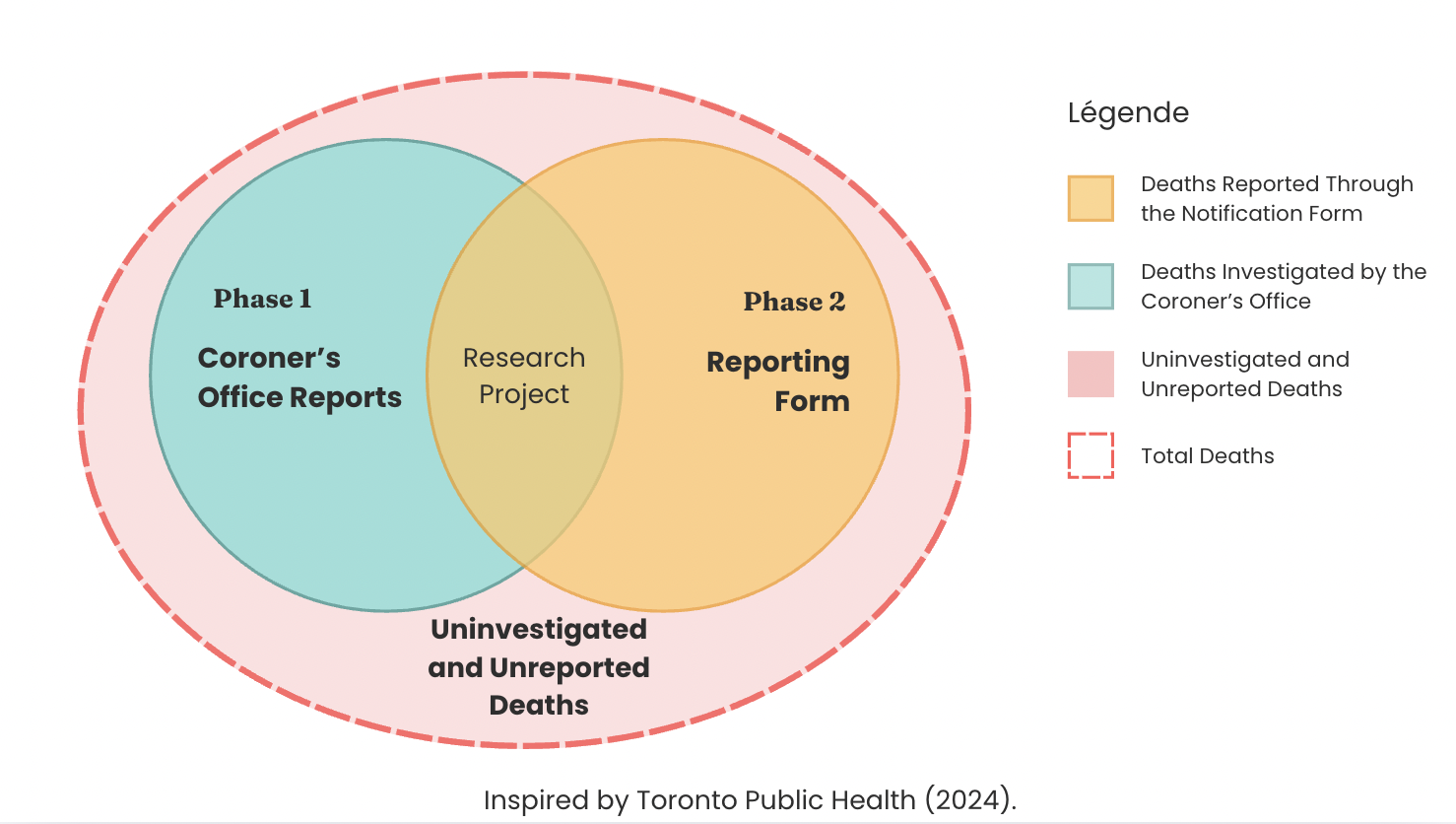
To obtain a more accurate picture of the current situation and document deaths among people experiencing homelessness in Quebec, the team cross-references two sources of information: coroner’s reports and reports of homeless deaths submitted through the community-accessible form.
Combining these two sources of information sheds light on the social and systemic fractures that contribute to the mortality of people experiencing homelessness. This methodology is inspired by and used by Toronto Public Health, which has been tracking deaths among people experiencing homelessness since 2017 through community collaboration.
Coroner’s reports
An analysis of coroner’s reports since 2020 provides a better understanding of the causes and circumstances that contributed to the deaths of people experiencing homelessness.
Reporting form for homelessness-related deaths
The reporting form for deaths of people experiencing homelessness in Quebec allows for the collection of additional information and the documentation of deaths that would not have been recorded by the Bureau du coroner.
Definition of homelessness
For the purposes of this research, homelessness is defined as: The situation of an individual, family, or community without stable, safe, permanent, and appropriate housing, or without the immediate prospect, means, or ability to acquire it.
The following situations are considered homelessness:
1. Unsheltered Individuals (Living on the Street)
Individuals living on the streets who generally do not access emergency shelters.
2. Individuals Using Shelter Services
Individuals relying on emergency shelters or other temporary accommodation services.
3. Provisionally Accommodated Individuals
- Staying with friends, acquaintances, or family members.
- Living in transitional or community-supported housing.
- In a motel or hotel
- In transitional and community-based housing.
- In a rooming house
- In an institutional setting following a period of homelessness (e.g., healthcare and/or criminal justice systems.)
Source of Definition: This research relies on the definition developed by the Canadian Observatory on Homelessness. Here is the link.
This framework represents the intersection of the two sources of information: coroner’s reports and reports of homeless deaths submitted through the available form. However, it highlights that many deaths of people experiencing homelessness go unrecorded and remain invisible in the available data.
Combining these two sources of information is essential to understanding homelessness-related mortality. Community collaboration is indispensable for documenting this reality, which affects many people experiencing homelessness.